
Why labs lose tenders they should win
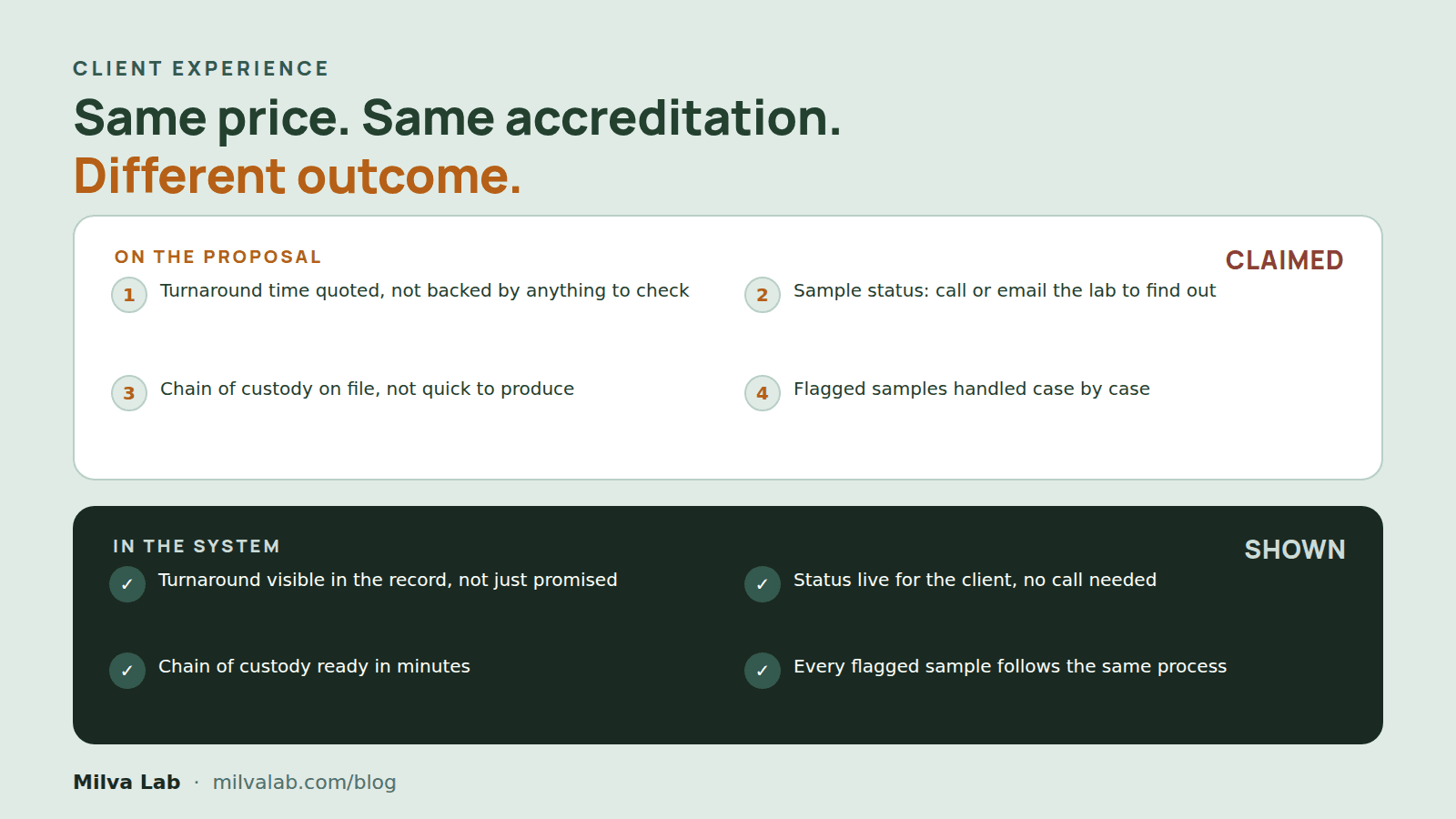
Labs often lose tenders to competitors with the same price and the same accreditation because those two things are table stakes, not differentiators. What tends to decide a close tender is what a lab can demonstrate about how it actually works: visible sample status, a chain of custody record it can produce on request, and a track record of hitting turnaround times. A lab that can show this, rather than just claim it in a proposal, has an edge that price and accreditation alone do not provide.
The tender comes back and the incumbent keeps the contract at the same price per sample and the same accreditation the challenger lined up in its proposal. On paper, nothing separated the two bids. In practice, something did, and it rarely shows up on a price sheet.
Why price and accreditation stop being the differentiator
Accreditation gets a lab onto the shortlist. It does not win the tender by itself, because every lab invited to bid usually holds the same one. Price sheets tend to converge too, once labs are quoting the same test panel at a similar volume. What is left to compare is everything that happens after the contract is signed: how fast a sample actually moves, how easy it is to check on, and what happens when something goes wrong with a shipment or a result.
- A turnaround time that is quoted in the proposal but not backed by anything the evaluator can check
- No way for the client to see where a sample stands without calling or emailing the lab
- A chain of custody record that exists on paper somewhere, but cannot be produced quickly if asked
- Inconsistent handling when a sample is delayed or flagged, because nothing is tracking it
What separates the labs that keep winning
A lab that runs on a digital system has something a paper-based competitor does not: proof. Turnaround is not just promised in the proposal, it shows up in how fast last week's samples actually moved. A prospective client can be shown, not told, what status tracking looks like. And when an accreditation body or a client asks for the chain of custody on a specific sample, the record is ready in minutes instead of pulled together from a filing cabinet.
- A client portal a reference client can point to, instead of a written promise about responsiveness
- A digital chain of custody record that is ready to produce on request, not reconstructed under pressure
- Sample status visible in the system, not dependent on someone remembering to call back
- The same process for every sample, so a flagged or delayed one gets handled consistently rather than depending on who picks up the phone
What good looks like
If nothing changes, the pattern holds: two bids that look identical on paper get decided by something neither lab can point to, and the lab with less to show keeps losing tenders it was technically qualified to win. Once a lab can demonstrate, not just describe, how it tracks a sample from intake to result, price and accreditation stop being a wash and start being the floor a stronger proposal is built on.
If your last tender came down to nothing you could really tell apart on paper, it is worth being able to show what your lab actually does once the sample arrives.
Ofte stillede spørgsmål
Why do labs lose tenders when their price and accreditation match the winner's?
Accreditation is a baseline for being invited to bid, and price sheets tend to converge. What tends to decide close tenders is what a lab can demonstrate about how it actually works, turnaround, traceability and communication, not what it promises on paper.
What do tender evaluators look for beyond price and accreditation?
Evidence of reliable delivery: visible sample status, a documented chain of custody, and a track record of hitting quoted turnaround times, ideally something the evaluator can see rather than take on faith.
Can a client portal help a lab win more tenders?
It gives a lab something concrete to point to during evaluation, real-time status a reference client can vouch for, instead of a written claim about responsiveness.
Does digital chain of custody matter in a tender evaluation?
It can. A documented, same-day chain of custody record answers a question evaluators and auditors often ask directly, and it is easier to demonstrate than to describe in a proposal.

Martin Mikkelsen
CCO, Milva Lab