Digital sample intake: what changes on day one
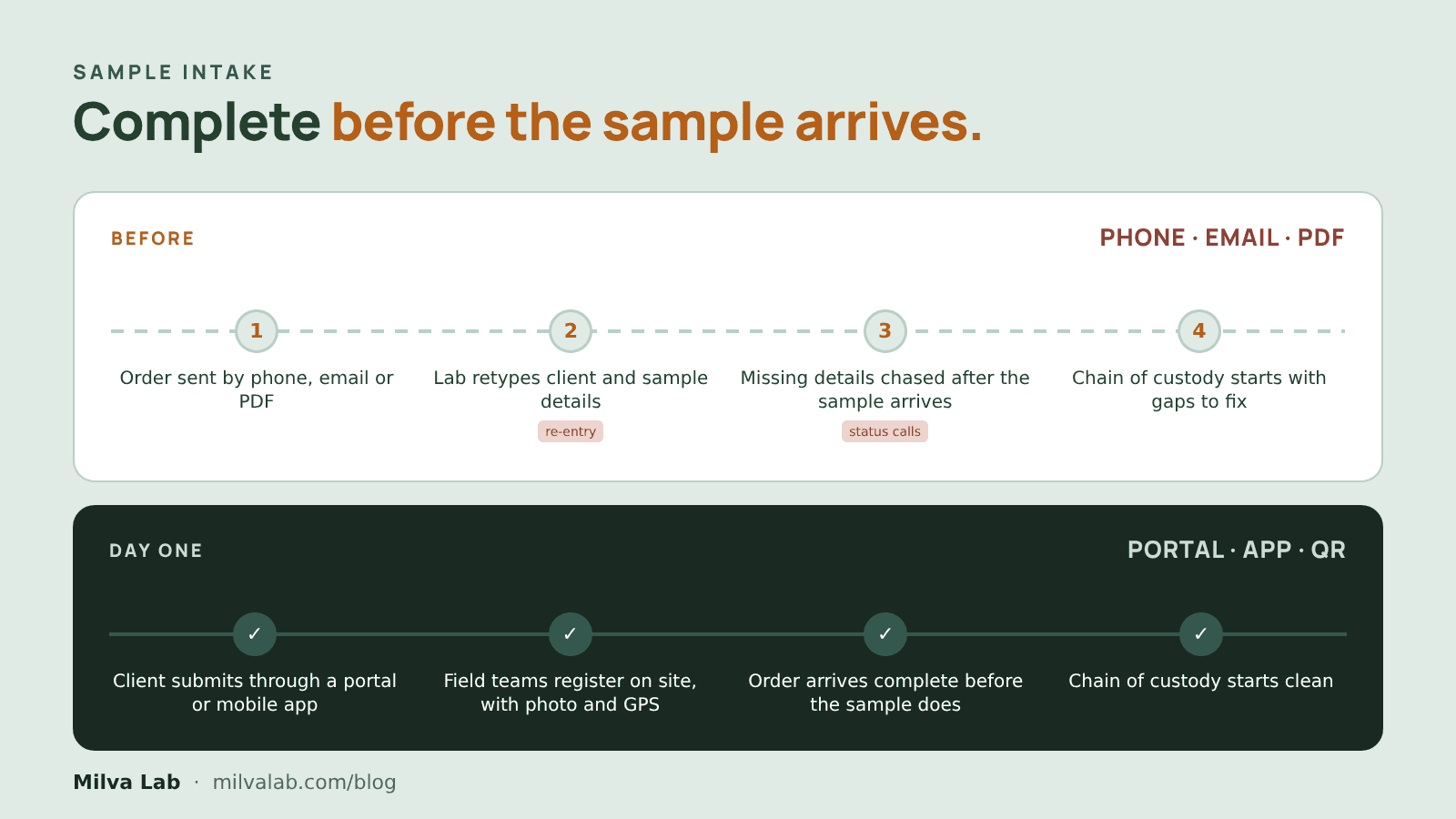
Digital sample intake changes what happens before a sample ever reaches the bench. Instead of a paper form, an email or a PDF that someone at the lab has to retype, the order, whether submitted by a client through a portal or registered on site by a field team, arrives already complete: client details, project reference, sample type and collection notes captured the moment it is submitted. On day one, that means fewer calls to chase missing information and a chain of custody record that starts clean instead of being reconstructed later.
Monday morning starts with samples that came in over the weekend and a stack of paper or PDF requisitions nobody has entered yet. Nothing is logged, assigned or scheduled until someone does that by hand, and the actual lab work waits behind it.
What slows a lab down at the point of intake?
An order placed by phone, email or PDF arrives as someone else's handwriting, an inbox attachment, or a scanned form. Before anything can move forward, someone at the lab has to read it, retype the client details, project reference and sample type into the system, and chase whatever is missing or unclear. Every one of those manual fields is a chance for the record to be wrong before the sample is even logged.
- Client or project details missing or illegible on a paper or PDF form
- The same information typed twice: once by the client or field team, once by the lab
- A weekend or after-hours drop-off landing as an unplanned Monday backlog
- A chain of custody record that starts with a gap instead of starting clean
What changes with digital sample intake?
Milva Lab moves the order itself online, so the record exists before the physical sample does. A client can submit a sample order through a branded portal with no download required, or a field team can register it on site through the Milva mobile app, coming soon to the App Store and Google Play. It works offline and syncs once it reconnects. Samples dropped off without a live submission can be logged by scanning a QR code at the drop point.
- Client details, project reference, sample type and collection notes captured at the moment of submission
- Photo and GPS capture at the sample level for field registrations
- Custom fields per test type and client, so the record only asks for what that sample actually needs
- The order reaches the lab with complete data before the sample arrives, with nothing to retype
Where does the chain of custody actually start?
A clean intake record is not a separate improvement from chain of custody. It is the first entry in it. The same handoffs, timestamps and signatures that keep a chain of custody record audit-ready later only hold up if the first entry was correct, so a lab that fixes intake is fixing the weakest link in the whole chain, not just the morning's paperwork.
If nothing changes, the pattern repeats every week: samples arrive before the paperwork catches up, someone retypes what a client or field team already typed once, and the record only becomes complete after someone chases down what is missing. With digital intake, the order is complete before the sample reaches the bench, and the rest of the chain of custody builds on that from the first entry, not the last correction.
Frequently asked questions
What is digital sample intake?
It is the process of capturing a sample order, client details, project reference, sample type and collection notes, digitally at the moment it is submitted, through a branded client portal, mobile registration for field teams, or a QR code at a drop point, instead of on paper, by email or as a PDF that the lab has to retype later.
What changes on day one when a lab switches to digital intake?
The order arrives at the lab complete, with full client and sample metadata, before the physical sample does. There is no separate paper form to fill in later, no call to chase a missing detail, and the chain of custody record starts clean instead of needing to be reconstructed.
Does a client need to download an app to submit a sample order?
No. Clients order through the branded portal with no download required. Field teams use the Milva mobile app, coming soon to the App Store and Google Play. It also works offline and syncs once they are back online.
Does digital intake replace chain of custody documentation?
No. Intake is the first step in the chain of custody, not a replacement for it. A clean digital intake record is what lets the rest of the chain, handoffs, lab workflow and reporting, stay complete without gaps.

Martin Mikkelsen
CCO, Milva Lab