
Turnaround time SLAs: how labs actually hit them
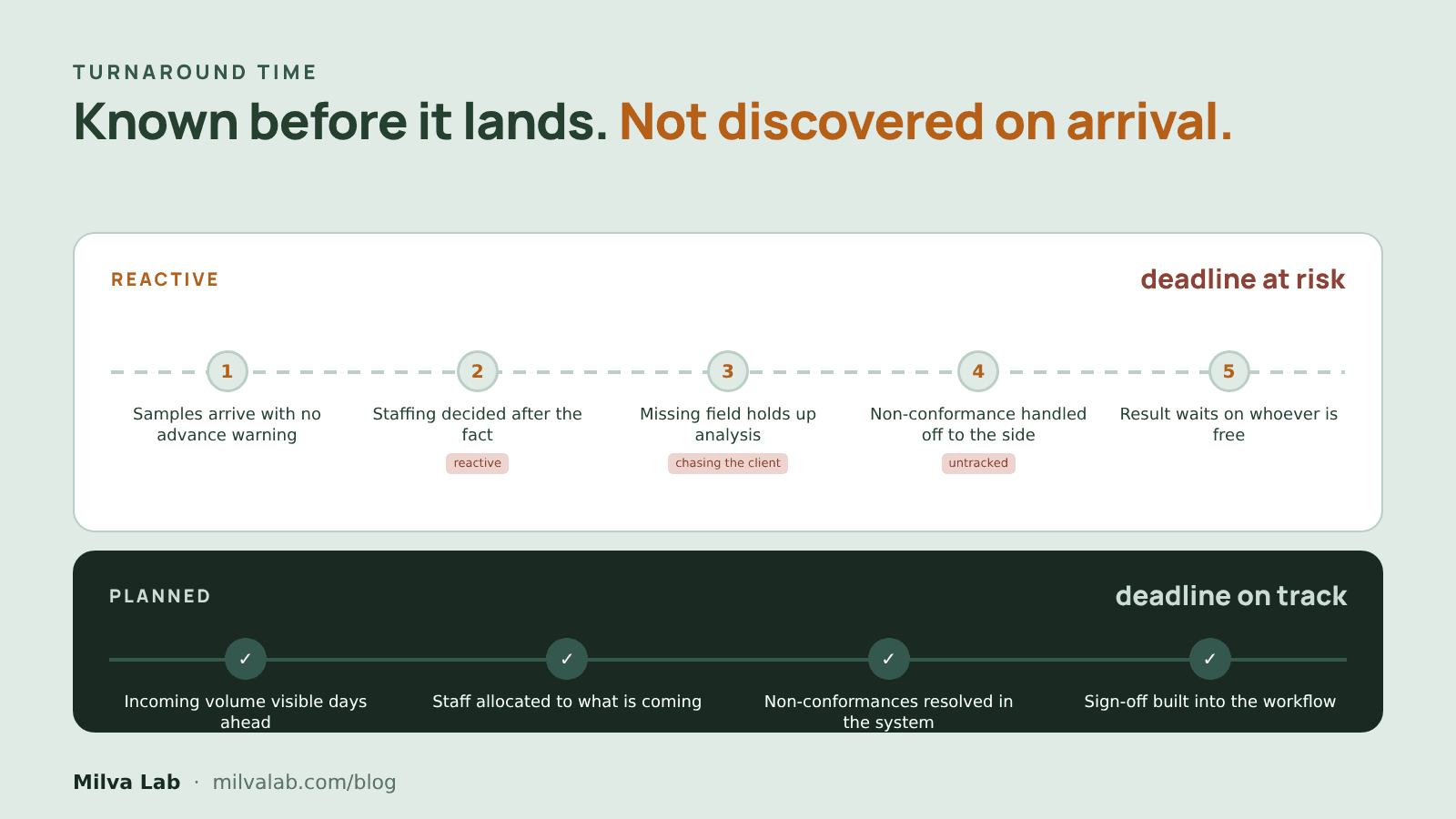
A lab hits its turnaround time SLAs by knowing its workload before it lands, not by working faster once it has. When incoming volume is visible hours or days ahead, staff can be allocated to the work that is actually coming instead of the work that already arrived. The deadline stops being a surprise on the day it is due and becomes a plan made in advance.
The client agreed a five-day turnaround when the contract was signed. Today is day four, and two samples for that project are still sitting unassigned in the queue, because the analyst who normally runs that test has been out since Tuesday. Nobody did anything wrong. This is just what happens when the week's workload becomes known the moment it is physically in front of someone, instead of the days before.
Why do testing labs miss turnaround time SLAs?
A turnaround time deadline is only as reliable as the planning behind it, and most labs plan around a backlog they cannot see until it arrives. Staffing gets decided reactively, after the samples are already on the bench, and every delay at intake or in the queue eats into a clock that started running the moment the client's contract said it would.
- Incoming volume is unknown until samples are physically on site, so staffing is reactive instead of planned
- A requisition missing a field holds up the start of analysis while someone chases the client for an answer
- A non-conformance found at the bench gets handled off to the side, outside the system, and the time it costs goes untracked
- A finished result waits on whoever happens to be free to sign it off, rather than moving on a schedule
What actually makes turnaround time predictable?
Milva Lab gives a lab manager visibility before the samples are physically there. Incoming volume shows up on the workload dashboard by client, project and sample type, hours or days ahead of arrival, so staffing is a decision made in advance instead of a reaction on the day.
- Real-time incoming volume dashboard, by client, project and sample type, visible before the samples physically arrive
- Workload allocation by analyst and sample type, based on what is actually coming rather than what is already on the bench
- Non-conformances flagged and resolved directly in the system, instead of handled off to the side and forgotten
- Approval and sign-off built into the workflow, so a finished result does not sit waiting on whoever happens to be free
What good looks like
If nothing changes, every SLA is a bet on how smooth the week happens to be: whether anyone calls in sick, whether a requisition arrives complete, whether the right person is free to sign off a result on the day it is due. With the week's volume visible in advance, staffing becomes a plan instead of a guess, and the deadline a client agreed to months ago is the same deadline the lab is actually working toward this week.
If your lab's turnaround time depends on how the week happens to go, it is worth seeing what full visibility into incoming workload looks like in practice.
Frequently asked questions
What is the biggest cause of missed turnaround time SLAs in a testing lab?
Most missed deadlines start with a workload the lab did not see coming: samples that arrive with no advance warning, and staffing that gets decided reactively once the backlog is already physically there.
How can a lab see its workload before samples arrive?
When orders are registered digitally at the point of submission, instead of appearing on a form once the sample lands, the workload dashboard shows what is coming, by client, project and sample type, hours or days before the delivery itself.
Does staffing based on real data reduce missed deadlines?
Yes. Allocating analysts to the work that is actually coming, instead of the work that has already arrived, turns the week into a plan rather than a reaction.
What else slows a sample down inside the lab, beyond staffing?
A non-conformance handled off to the side, outside the system, or a finished result waiting on whoever happens to be free to sign it off, both add time that nobody is tracking. Resolving both inside the same workflow keeps the clock moving.

Martin Mikkelsen
CCO, Milva Lab